
Exploring the Hunger-Fullness Scale in Intuitive Eating
Hunger is often talked about as if it is simple. You feel hungry, you eat, you feel full. But for many people, hunger and fullness feel much more complicated than that.
If you have spent years dieting, ignoring hunger, following food rules, or feeling disconnected from your body, these signals can feel confusing or unreliable. Some people notice hunger clearly in their stomach, while others experience it through changes in mood, energy, focus, or cravings.
The hunger-fullness scale is one tool that can help you explore these signals with curiosity rather than judgment. It gives language to the physical and mental sensations that come up around food so you can better understand what your body may be asking for. It’s important to remember that this scale is not a set of rules. It’s simply a framework that can help guide awareness as you rebuild trust with your body.
This article was updated in March 2026 to reflect an expanded hunger-fullness guide.
Understanding Hunger and Fullness Cues
The hunger-fullness scale can be a helpful tool for reconnecting with your body's internal signals. These signals guide us toward nourishment, satisfaction, and rest. But for many people, these cues do not feel clear or consistent. For some, hunger feels obvious, like a stomach growling or energy dropping. For others, hunger may show up as irritability, brain fog, restlessness, or difficulty concentrating.
Hunger and fullness cues are shaped by many factors, including:
chronic dieting
eating disorders
stress or trauma
medications
medical conditions
neurodivergence
sleep patterns
hormonal shifts
Because of this, hunger and fullness might sometimes feel muted, confusing, inconsistent, or even absent. If your cues feel unreliable, that doesn’t mean you’re doing intuitive eating wrong. Often, it simply means your body needs time, consistency, and support to feel safe communicating again.
Reconnecting with these signals can feel like getting to know an old friend again. With patience and curiosity, your body can begin sharing information about what it needs and when.
How Dieting Disrupts Hunger and Fullness Cues
Many people feel disconnected from their hunger and fullness cues because dieting and food restriction disrupt the body’s natural feedback systems. Diet culture often encourages us to ignore hunger, delay eating, follow rigid schedules, or stop eating based on external rules instead of internal cues. Over time, this can make hunger feel intense or urgent rather than gradual and manageable.
The encouraging news is that these cues are not broken. They often re-emerge when the body experiences consistent nourishment and predictable eating patterns.
Think of your hunger and fullness cues as a friend who stopped reaching out after not being answered. Showing up consistently by feeding yourself regularly helps signal to your body that it’s safe to communicate again. This often looks like eating satisfying meals or snacks every 2–4 hours, even if hunger cues feel silent. Over time, these consistent actions signal to your body that it can trust you to meet its needs, and your cues will become more reliable as a result.
Regular check-ins with your body can also help. Even if you don’t immediately feel hunger or fullness cues, simply pausing to notice physical sensations like stomach growling, lightheadedness, or comfort after eating can help you build a stronger connection. Part of intuitive eating is learning your personal hunger language.
What is the Intuitive Eating Hunger Scale?
The hunger-fullness scale is a framework used in intuitive eating to help people notice signals related to hunger, satisfaction, and fullness. It is not meant to tell you exactly when or how much to eat. Instead, it provides language that helps people observe how their body feels throughout the eating process. Think of it as a conversation starter between you and your body.
Everyone’s experience of hunger and fullness will look a little different. The scale simply helps bring awareness to those experiences. It’s also important to remember that this scale reflects just one aspect of hunger. There are many different types of hunger that influence when and why we eat.
How to use the Intuitive Eating Hunger-Fullness Scale
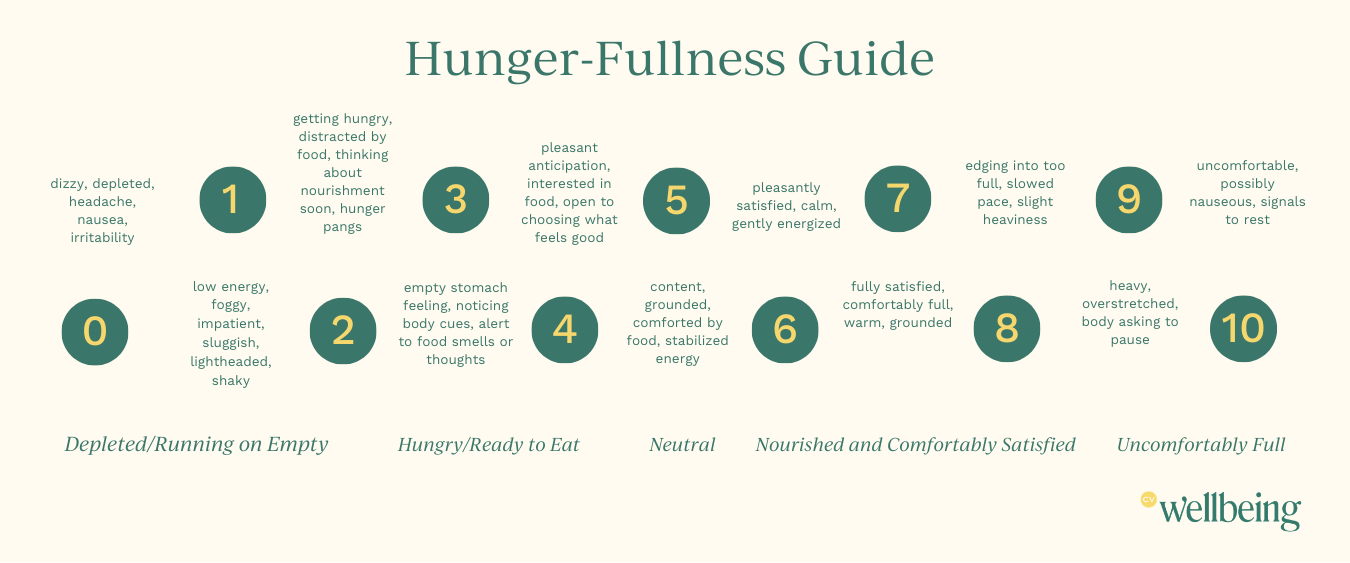
Too Hungry → Depleted or Running on Empty (0-1)
0 - Overwhelmed, dizzy, depleted, headache, nausea, irritability
1 - Low energy, foggy, impatient, sluggish, lightheaded, shaky
At this end of the scale, the body is running on very little fuel. Hunger may feel intense, urgent, or even uncomfortable. You might notice physical sensations like dizziness, shakiness, nausea, or headaches. Mentally, it may be harder to focus, regulate emotions, or make decisions about food.
When the body reaches this level of hunger, it is often responding to a longer stretch without nourishment. Blood sugar may be low, and the brain is signaling that energy is needed quickly. Many people also notice that food choices feel more reactive or urgent at this point, which is a completely normal biological response.
Hungry → Ready to Eat
2 - Getting hungry, distracted by food, thinking about nourishment soon, hunger pangs, stomach growling
3 - Ready to eat, empty stomach feeling, noticing body cues, alert to food smells or thoughts
4 - Pleasant anticipation, interested in food, open to choosing what feels good
This range often reflects the early stages of hunger. For some people, it may feel like stomach sensations such as growling or emptiness. For others, hunger might show up through thinking about food more often, feeling slightly distracted, or noticing food smells more strongly. Many people find that eating somewhere in this range feels manageable and supportive for their energy and mood. Food choices may feel easier and more thoughtful when the body is not in an urgent state of hunger.
At the same time, it’s normal for eating to happen at many different points on the scale. Life schedules, social situations, and personal needs all influence when eating occurs.
Neutral → Settling, Steady, Content
5 - Content, grounded, comforted by food, stabilized energy
This point often feels like a place of steadiness in the body. Hunger has eased, and fullness has not yet become noticeable. Energy may feel stable and comfortable.
You might notice this point between meals or briefly during a meal before fullness develops. For some people it feels like a moment of calm or balance. It can be helpful to notice how your body transitions through this space during eating. Many people pass through neutrality as they move from hunger toward satisfaction.
Satisfied → Nourished and Comfortably Satisfied
6 - Pleasantly satisfied, calm, gently energized
7 - Fully satisfied, comfortably full, warm, grounded
This range often represents comfortable satisfaction. The body feels nourished and supported, and hunger has been adequately addressed. Many people describe this state as feeling calm, steady, and content after eating.
At this point, eating may naturally slow down or stop because the body has received enough nourishment for the moment. Satisfaction can also include emotional or sensory contentment, such as enjoying the taste of food or feeling relaxed after a meal. Learning to notice satisfaction can be just as important as noticing hunger. It helps build awareness of what feeling nourished and supported in the body actually feels like.
Too Full → Body Signaling Pause
8 - Edging into too full, slowed pace, slight heaviness
9 - Heavy, overstretched, body asking to pause
10 - Uncomfortable, possibly nauseous, signals to rest
At the higher end of the scale, fullness becomes more noticeable and may move into discomfort. The stomach may feel heavy or stretched, and the body might signal that it would like a break from eating.
These experiences happen to everyone at times. Social gatherings, celebrations, distraction while eating, or simply enjoying a meal can sometimes lead to eating past comfortable fullness. Rather than viewing these moments as mistakes, they can simply be opportunities to notice how the body feels and what it might need next. Often, the body naturally returns to balance at the next meal or snack.
Over time, paying attention to these signals can help build a more flexible and compassionate awareness of your body’s needs.
Why Listen to Hunger and Fullness Cues?
Physiological Benefits
When we experience extreme hunger, our blood sugar and blood pressure drop and our bodies start signaling a decline in function. There are expected changes in our hormone and neurotransmitter production, so we are likely to experience the effects of deprivation as physical symptoms. These may include feeling tired, dizzy, shaky, moody, and nauseous. Can you recall a time when you went without eating and felt this way? Now you have a new understanding of why and maybe a new respect for how much your body does to protect you and get its needs met!
Adequate intake and Energy Balance
Our hunger and fullness cues assist us in meeting our individualized daily energy needs. Our bodies are our best indicators of how much food we need daily, communicated through hunger and fullness. When we do not meet our energy needs, our body also sends us signals - which may be increased hunger and specific cravings, perhaps towards sweets. If we continue to nourish our bodies inadequately, our hunger cues become less reliable.
Rebuilding Body Trust
It will be very challenging to eat intuitively if you are not trusting your body, and your body is, therefore, unable to depend on you. It is possible to lose the sense of hunger or fullness because we have not listened to or honored our body's signals. This is likely to happen when restriction with food (either intentional or not) has taken place, and we "push off" hunger. We need to re-establish that trust to regain a felt sense of our body's cues. How? By regularly feeding our bodies when we notice hunger (between 2-4) and giving ourselves time to notice fullness (between 7-8), at which time it feels natural to stop eating. By doing this, we listen to our body's cues and build trust in working/communicating in unison.
Positive Relationship with food
The relationship we create with food is also essential to hunger and fullness. Sometimes, honoring your hunger and fullness cues will likely mean choosing foods you once felt or still feel like are "off limits." Diving deeper into these beliefs with food and creating more permission with food is necessary to honestly and adequately honor your hunger and fullness. Creating a more positive relationship with food and tuning into your body allows a deeper understanding of your food needs or desires.
Listening to your body is not about perfection. It’s about creating a relationship built on trust, respect, and care. Remember, there’s no one-size-fits-all approach to intuitive eating, and that’s part of what makes this journey so personal and empowering.
Want Support with Intuitive Eating?
Reconnecting with hunger and fullness cues can take time, especially if your body has experienced years of dieting, stress, or medical challenges. Working with a dietitian can help you explore these signals with curiosity and support.
If you are interested in rebuilding trust with your body or learning more about intuitive eating, the dietitians at CV Wellbeing are here to help. You can learn more about our nutrition counseling services or schedule a session with a dietitian to explore intuitive eating in a supportive and personalized way.
FAQs about the Hunger-Fullness Scale
-
The hunger-fullness scale is a tool ranked from 1 to 10 that helps you identify and respond to your body’s natural hunger and fullness signals. The lower numbers (1-4) indicate hunger, the middle (5) represents a neutral phase, and the higher numbers (6-10) signal increasing fullness.
-
You can use the scale to guide your eating habits by:
Eating when hunger falls between 2-4 (mild to moderate hunger).
Stopping when fullness reaches 7-8 (comfortable satisfaction).
This practice helps you honor your body’s needs without waiting until you’re overly hungry or uncomfortably full.
-
Ignoring hunger for too long (letting it drop to 1) can lead to physical symptoms like dizziness, shakiness, fatigue, and irritability. Prolonged food deprivation can also make it harder to recognize hunger cues over time and may lead to eating past fullness later.
-
Yes, the scale can help prevent overeating by encouraging you to tune into your body’s fullness cues. By stopping at a 7-8 rather than continuing to 9-10 (uncomfortably full), you can feel satisfied without discomfort.
-
If hunger or fullness cues feel unreliable, it may be due to food restriction, irregular eating patterns, or a disconnection from your body’s signals. Rebuilding trust takes time. Consider seeing a dietitian to help you build hunger cues back.

Written by Lauren Hebert, MS, RDN, LD, Registered Dietitian Nutritionist at CV Wellbeing